
The short answer
Most Detroit-metro mold jobs land between $1,025 and $2,517
Angi's 2026 Detroit-area data puts the local average at $1,714, with most homeowners paying $1,025 to $2,517. That sits below the national average of roughly $2,368 to $2,400, where most projects run $1,200 to $3,750.
Metro Detroit is a large area and West Bloomfield is at the affluent end of it. Home size is one of the stated cost drivers in every published guide, so larger lake-area homes with finished basements sit toward the upper half of any range rather than the bottom.
These are published ranges, not quotes. Nobody can price a mold job without seeing the moisture source. Anyone who gives you a firm number over the phone is guessing.
At a glance
| Detroit metro average | $1,714 |
|---|---|
| Detroit metro typical range | $1,025 – $2,517 |
| National average | $2,368 – $2,400 |
| National typical range | $1,200 – $3,750 |
| Per square foot | $10 – $25 |
| Small isolated patch | $300 – $800 |
| Whole-house remediation | $10,000 – $30,000 |
Sources listed in full below.
Estimate it yourself
Mold removal cost estimator
This works the way the industry prices the job: a published per-square-foot rate applied to the affected area. Those rates already include containment, protective equipment and disposal, so nothing is added on top of them.
A patch behind one bathroom vanity is often under 10 sq ft. A wall of a finished basement is commonly 100–400 sq ft.
Difficult access is the single biggest multiplier in the published data — not the species of mold.
Published range for that work
$1,000 – $2,500
Based on $10–$25 per sq ft × 100 sq ft.
Call for an Estimate: (248) 742-4981An estimate, not a quote. The moisture source decides the real number, and that has to be seen.
By location
What it costs by area of the home
Published whole-job ranges. Use these as a sanity check on any estimator output — including the one above.
| Where the mold is | Published range | What drives the top end |
|---|---|---|
| Basement | $500 – $3,000 up to $15,000 if the whole basement is affected | Finished walls and flooring have to come out to reach the growth behind them. |
| Attic | $1,000 – $4,000 up to $7,000 with a long-running roof leak | Insulation removal and replacement, plus working in a low, hot space. |
| Crawl space | $500 – $4,000 | Standing water, a failed vapour barrier, or subfloor that needs replacing. |
| HVAC and air ducts | $500 – $4,000 typical job $1,000 – $2,500 | Number of vents and total duct run. Antimicrobial treatment adds to plain cleaning. |
| Whole house | $10,000 – $30,000 | Multiple rooms, structural drying, and reconstruction after removal. |
| Small isolated patch | $300 – $800 | Effectively a minimum call-out. Under about 10 sq ft on a hard surface is often a DIY job. |
Ranges overlap because the published sources measure slightly different jobs. Where they disagree, both ends are shown rather than averaged into a single misleading number.
Separate services
Inspection and testing are priced separately
Finding the mold, identifying it, and removing it are three different jobs. Only the third is remediation, and the first two are not included in the ranges above.
Mold inspection
$303 – $1,045
Average around $671. Homes under 4,000 sq ft commonly run $300–$400; above that, $700–$900. This is the visual and moisture survey that finds the source.
Mold testing
$250 – $500
Air and surface sampling to identify species and spore counts. Lab analysis is commonly $30–$100 per sample and is often bundled into that fee.
Do you need testing?
Often not
If you can see and smell it, testing rarely changes the remediation plan — the method is the same regardless of species. Testing earns its cost when the source is hidden, when a sale or claim needs documentation, or to confirm clearance afterwards.
A Michigan-specific point about who does what
Florida, Texas and Louisiana legally bar one firm from both assessing and remediating the same job, precisely because the assessor would be pricing their own work. Michigan has no such rule, and no mold licence at all. So here, one company may do both — which means the incentive those other states legislated against is yours to watch for. If the company that inspects also quotes the removal, a second opinion costs you one inspection fee. More on Michigan mold law →
What moves the number
Six things that actually change the price
1. Affected area
The base multiplier. Published rates run $10–$25 per square foot for most work.
2. Access
Behind finished walls, inside a crawl space, or up in a tight attic pushes rates to $25–$30 per square foot.
3. Materials affected
Drywall, carpet and insulation are porous — they get removed and replaced. Tile and concrete get cleaned in place.
4. The moisture source
Remediation without fixing the leak or the humidity means paying twice. The repair is a separate cost and often the larger one.
5. Contamination category
Clean water is one job. A sewage backup is another entirely — those run $8,000–$15,000 and up in this metro.
6. Reconstruction
Remediation removes material. Putting drywall, paint and flooring back is usually quoted separately. Ask which your number includes.
What does not change the price: the colour
“Black mold” is a marketing term, not a species and not a price tier. It usually means Stachybotrys chartarum. Published data does show higher costs on some black mold jobs, but the reason is the extra containment and protective equipment used when a hazardous species is confirmed — and the fact that it tends to be found in jobs that were already large and wet. A small patch of Stachybotrys on tile is a small job. More on black mold →
If a quote jumps sharply because someone said the words “black mold” without a lab result, ask what specifically changed about the work.
Locally
Why West Bloomfield quotes skew toward basements
West Bloomfield Township holds roughly 24 lakes and about 1,859 acres of surface water. Homes near Cass, Pine, Orchard, Walnut and the Straits lakes sit on a high water table, and that shows up as basement and crawl space moisture rather than roof leaks.
It matters for cost because finished basements are the expensive case. The growth is usually behind drywall, under carpet or inside the framing, which is the “hard access” band in the data, not the surface-cleaning band.
Michigan's humid summers and freeze-thaw cycling make this a recurring pattern rather than a one-off event. Two published cost drivers — humidity and older housing stock — both apply here.
Why basements here, specifically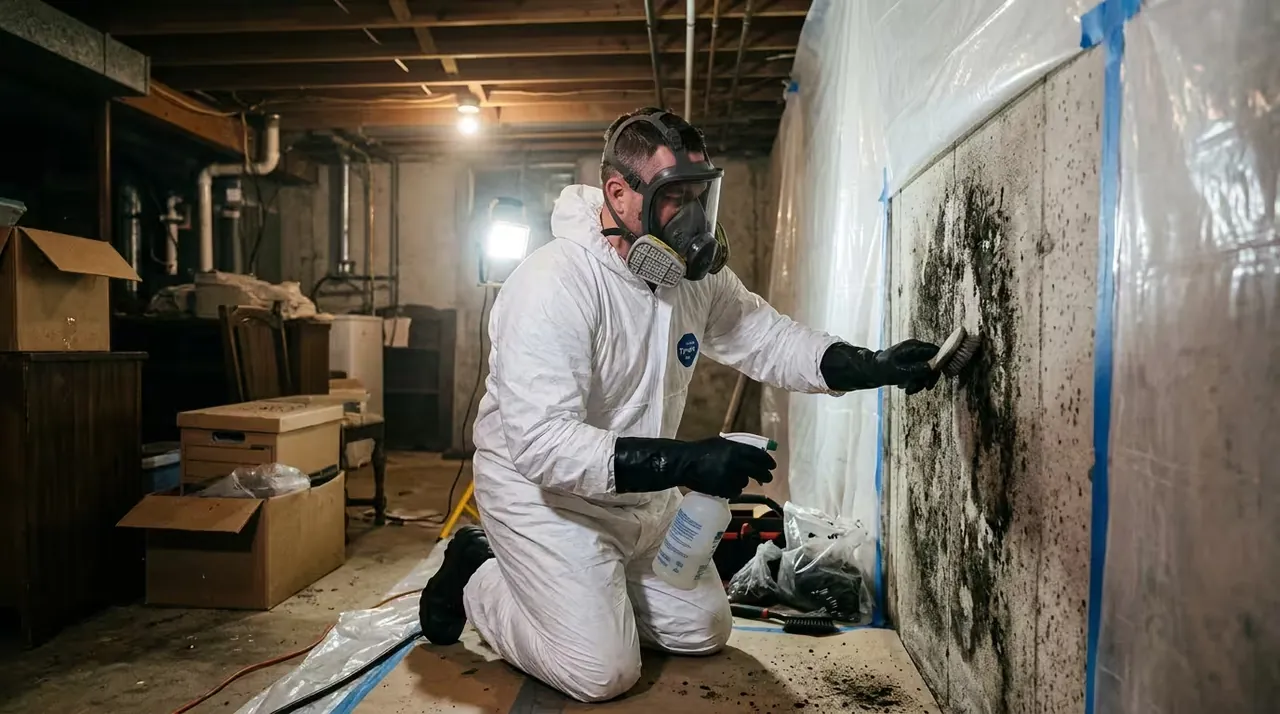
Questions
Mold removal cost FAQ
How much does mold removal cost in West Bloomfield?
Is mold removal cheaper in Michigan than the national average?
Does black mold cost more to remove?
How much does a mold inspection cost, and is it included?
Does homeowners insurance cover mold removal in Michigan?
Why will nobody give me a price over the phone?
Should I get more than one estimate?
Where these numbers come from
Sources
Every figure on this page comes from a published industry cost guide. None of it is our own pricing, and we invent no numbers. Figures current as of September 2026.
- Angi — How Much Does Mold Remediation Cost? (2026 data)
National average and typical range; per-square-foot rates; black mold cost factors. - Angi — Mold Remediation Cost in Detroit, MI
Detroit-metro average of $1,714 and the $1,025–$2,517 typical range. - HomeAdvisor — Mold Removal Cost
Per-square-foot rates of $10–$25 and the cost factors list. - HomeAdvisor — Mold Inspection Cost
Inspection range $303–$1,045, average $671, and the by-home-size bands. - HomeGuide — Mold Removal and Remediation Cost
Ranges by area of the home: basement, attic, crawl space, whole house. Mold testing $250–$500. - This Old House — Mold Remediation Cost (2026 guide)
Attic and basement upper bounds; access as a cost multiplier. - RestoreAdvisor — Mold Remediation Detroit MI
Local $1,200–$5,500 job range, $300–$800 small patches, and sewage-contaminated basement figures. - Angi — Air Duct Cleaning Cost
Duct cleaning baseline, and HVAC mold ranges with antimicrobial treatment.
Where sources disagree, both figures are shown rather than blended. Published per-square-foot rates already account for containment, protective equipment and disposal, so this page does not add those as separate line items on top — doing so would overstate a job by roughly a quarter.
Get a real number for your home
The ranges above tell you what is reasonable. A look at the actual moisture source tells you what it costs. Call and describe what you are seeing.
Call for an Estimate: (248) 742-4981Mon–Fri: 9AM – 7PM · Sat: 11AM – 5PM · Sun: 11AM – 3PM